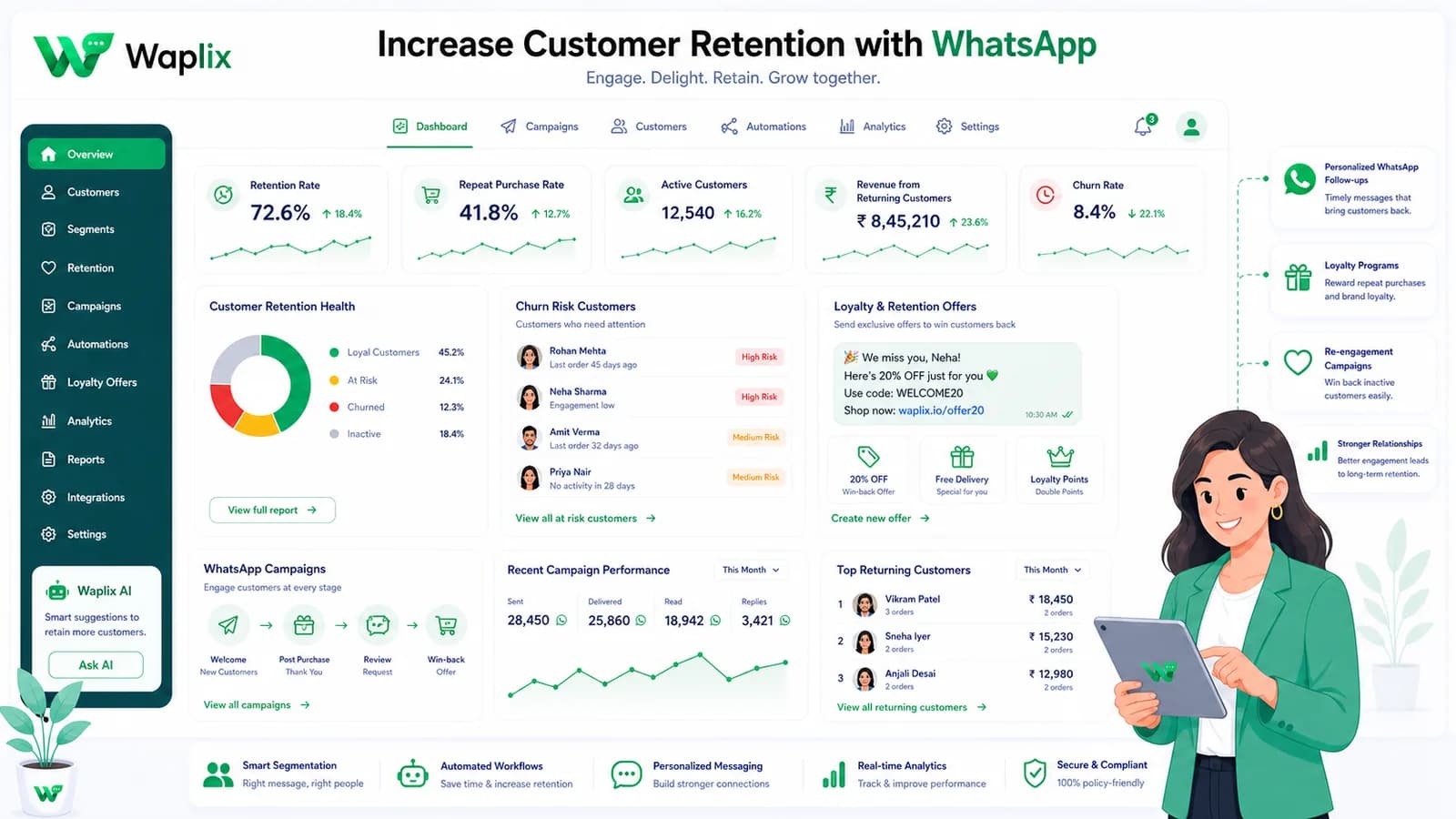
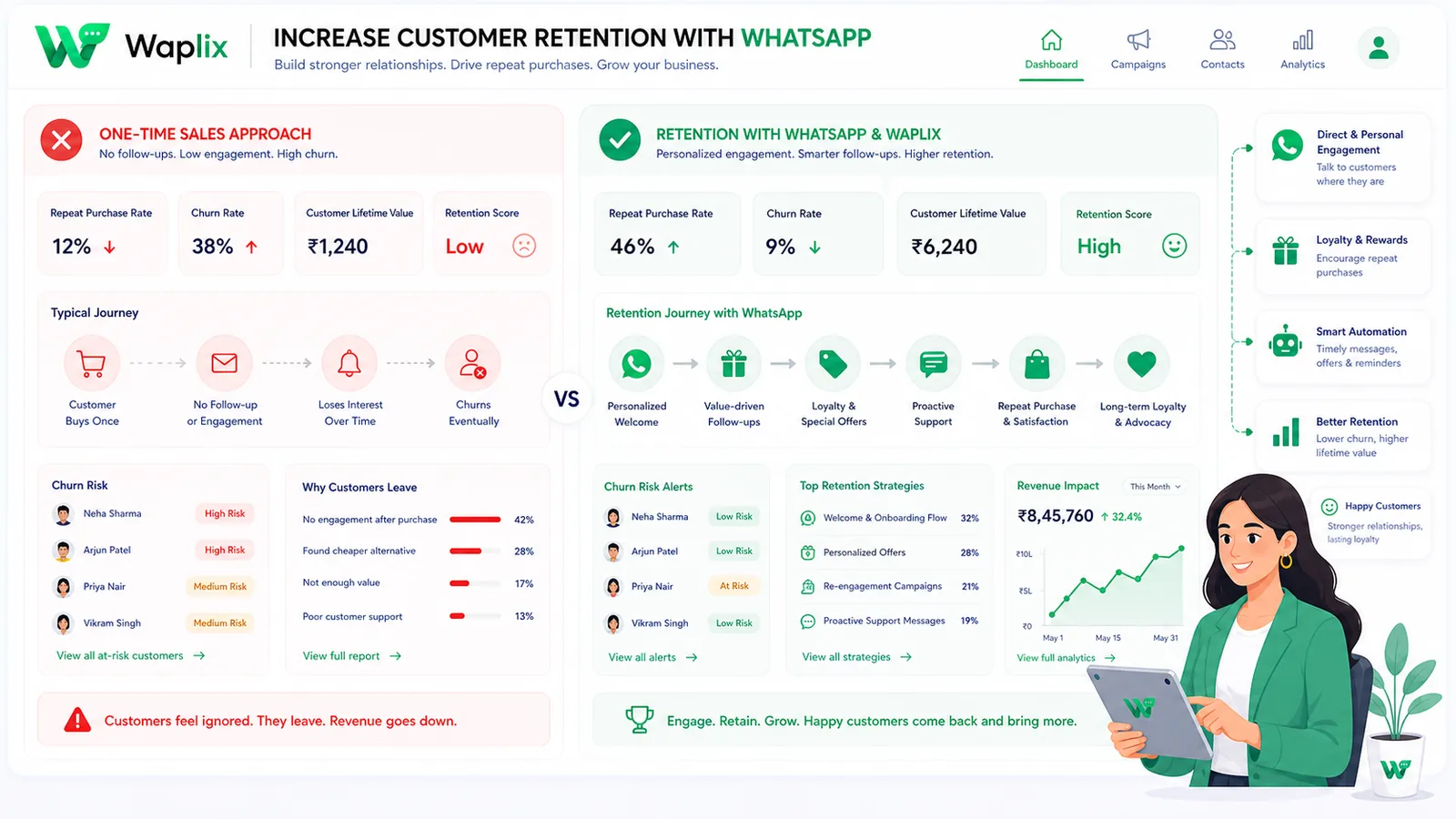
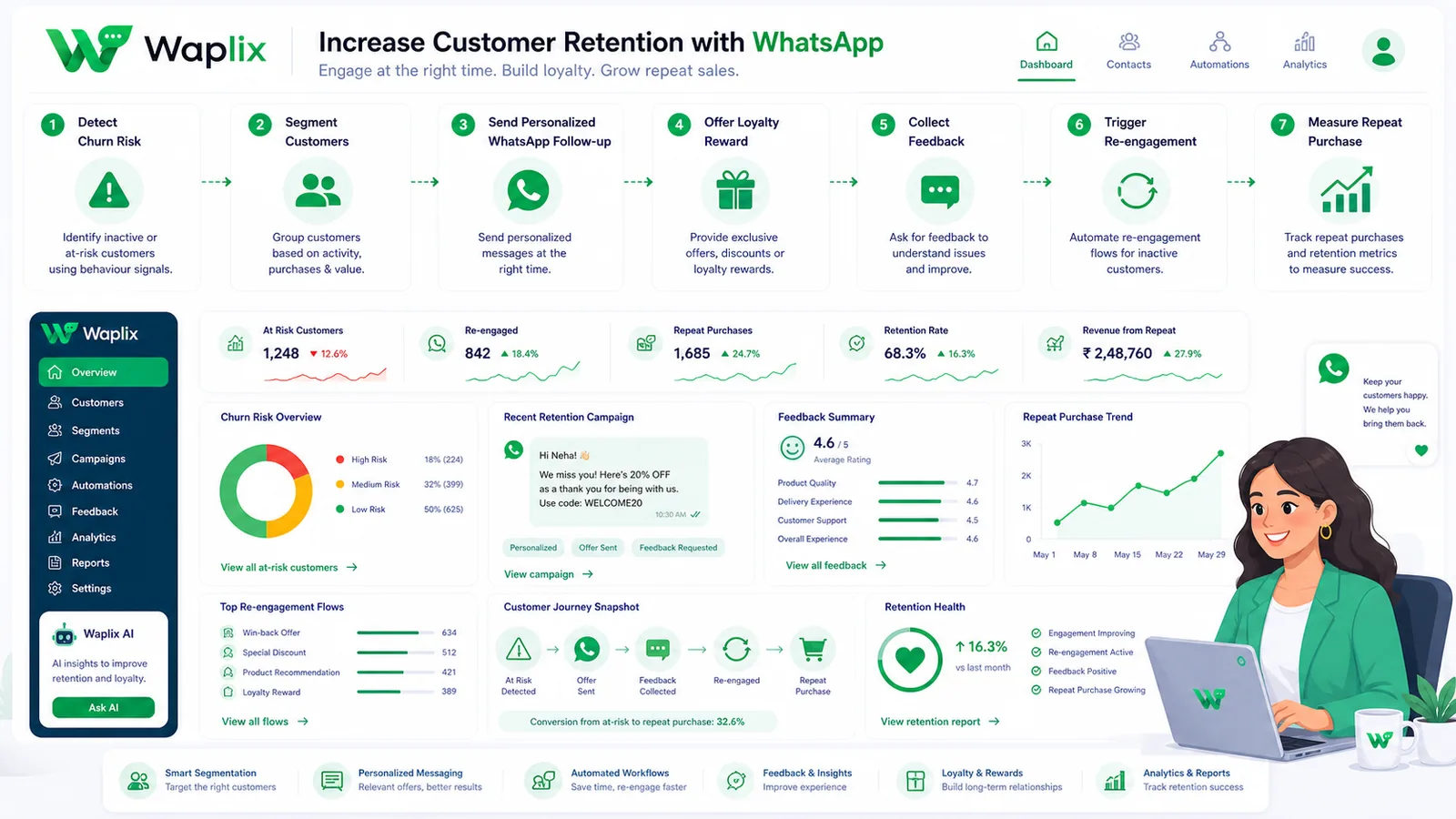
Acquiring new customers costs five to seven times more than keeping existing ones. WhatsApp gives retention teams a direct, high-visibility channel for follow-ups, feedback, loyalty rewards, and win-back campaigns—when consent and timing are handled correctly.
Oct 17, 2025 11 min read By Waplix Team
Share:
Automate retention workflows with Waplix
Customer retention is the single most profitable lever in most businesses. A modest improvement in retention rate can multiply lifetime revenue because repeat buyers spend more, cost less to serve, and refer others. Yet many teams spend the majority of their budget on acquisition while neglecting the customers they already have.
Email newsletters and loyalty apps help, but open rates keep declining and app fatigue is real. WhatsApp occupies a different space: it is where customers already spend their time, messages are read within minutes, and two-way conversation is native. For retention—where timing, relevance, and personal touch matter most—that combination is powerful.
This guide explains how to use WhatsApp as a retention channel: post-purchase follow-ups, feedback collection, win-back campaigns, anniversary and birthday messages, exclusive offers, subscription renewal reminders, and churn prevention workflows.
Quick answer: WhatsApp retention works best when you combine lifecycle-triggered messages—post-purchase check-ins, renewal reminders, re-engagement nudges—with genuine personalization and fast human follow-up when customers reply.
Connect CRM events to WhatsApp templates, build multi-step retention flows, and track re-engagement from one platform.
Acquisition fills the funnel. Retention determines how much value flows through it. Businesses with strong retention compound growth because each new customer adds to a growing base of repeat buyers instead of replacing churned ones.
WhatsApp retention outperforms email on visibility, speed, and two-way engagement for lifecycle touchpoints.
Retention method
Strength
Common weakness
Email drip campaigns
Low cost, rich content
Low open rates, promotions tab burial
Loyalty apps
Gamification, points tracking
App fatigue, low install rates
SMS campaigns
High deliverability
Per-message cost, plain text only
Push notifications
Instant for app users
Only reaches installed audience
WhatsApp lifecycle messaging
High read rates, rich media, two-way replies
Requires API, templates, consent management
Direct mail
Tangible, low competition
Slow delivery, high cost per piece
WhatsApp does not replace your entire retention stack. It fills the gap between email (often ignored) and phone calls (expensive and intrusive) with a channel that feels personal, arrives instantly, and lets customers respond on their own schedule.
Key takeaway
Retention is not a single campaign—it is a system of lifecycle touchpoints. WhatsApp excels at the time-sensitive, personal ones: renewals, check-ins, win-backs, and exclusive offers.
Seven WhatsApp retention strategies that work
Each strategy targets a specific moment in the customer lifecycle. Combine them into a cohesive retention flow rather than running them in isolation.
Send a check-in 3–7 days after delivery: confirm satisfaction, offer usage tips, and invite questions. This builds trust before asking for anything else.
02
Feedback loops
Ask for a quick rating or review at the right moment—after the customer has had time to use the product. Keep it to one question with reply buttons for frictionless responses.
03
Win-back campaigns
Reach lapsed customers 60–90 days after their last purchase with a personalized re-engagement message. Reference their past purchase and offer a reason to return.
04
Anniversary and birthday messages
Celebrate customer milestones with a personal message and an exclusive offer. These feel genuine when they reference the actual relationship, not just a calendar date.
05
Exclusive offers for loyal customers
Reward high-value segments with early access, member-only discounts, or VIP previews sent via WhatsApp before public launch.
06
Subscription renewal reminders
Alert customers before their subscription expires with a renewal link, usage summary, and clear instructions. Prevent involuntary churn from expired cards or forgotten renewals.
Strategy 7: Churn prevention workflows
Monitor engagement signals—declining usage, support ticket patterns, missed logins—and trigger proactive outreach before the customer decides to leave. A well-timed "we noticed you haven't logged in" message with a help offer can prevent cancellation.
Tip: Not every strategy suits every business. Start with post-purchase follow-ups and subscription renewals—they have the clearest ROI—then layer in win-backs and loyalty offers as you build confidence.
Traditional retention vs WhatsApp retention
Most retention programs rely on email sequences and loyalty apps. WhatsApp changes the dynamics by adding immediacy, conversation, and mobile-native engagement.
Dimension
Traditional retention
WhatsApp retention
Message visibility
15–25% email open rates
80–95% read rates within hours
Response speed
Hours to days for email replies
Minutes—customers reply in the same thread
Personalization
Mail merge variables in templates
Dynamic templates with CRM data, rich media, and buttons
Two-way conversation
Reply-to email often goes to no-reply inbox
Native two-way chat routed to shared inbox
Renewal reminders
Often buried in promotions tab
Direct notification with one-tap renewal link
Win-back campaigns
Multi-email drip over weeks
Single high-impact message with reply option
Feedback collection
Survey links with low completion rates
Quick reply buttons for instant ratings
Cost structure
Low per-message, high volume
Per-template cost, but higher conversion per send
Best approach: Use WhatsApp for high-priority, time-sensitive retention touchpoints and email for broader, content-rich lifecycle communications. Coordinate both to avoid message fatigue.
Building a WhatsApp retention workflow
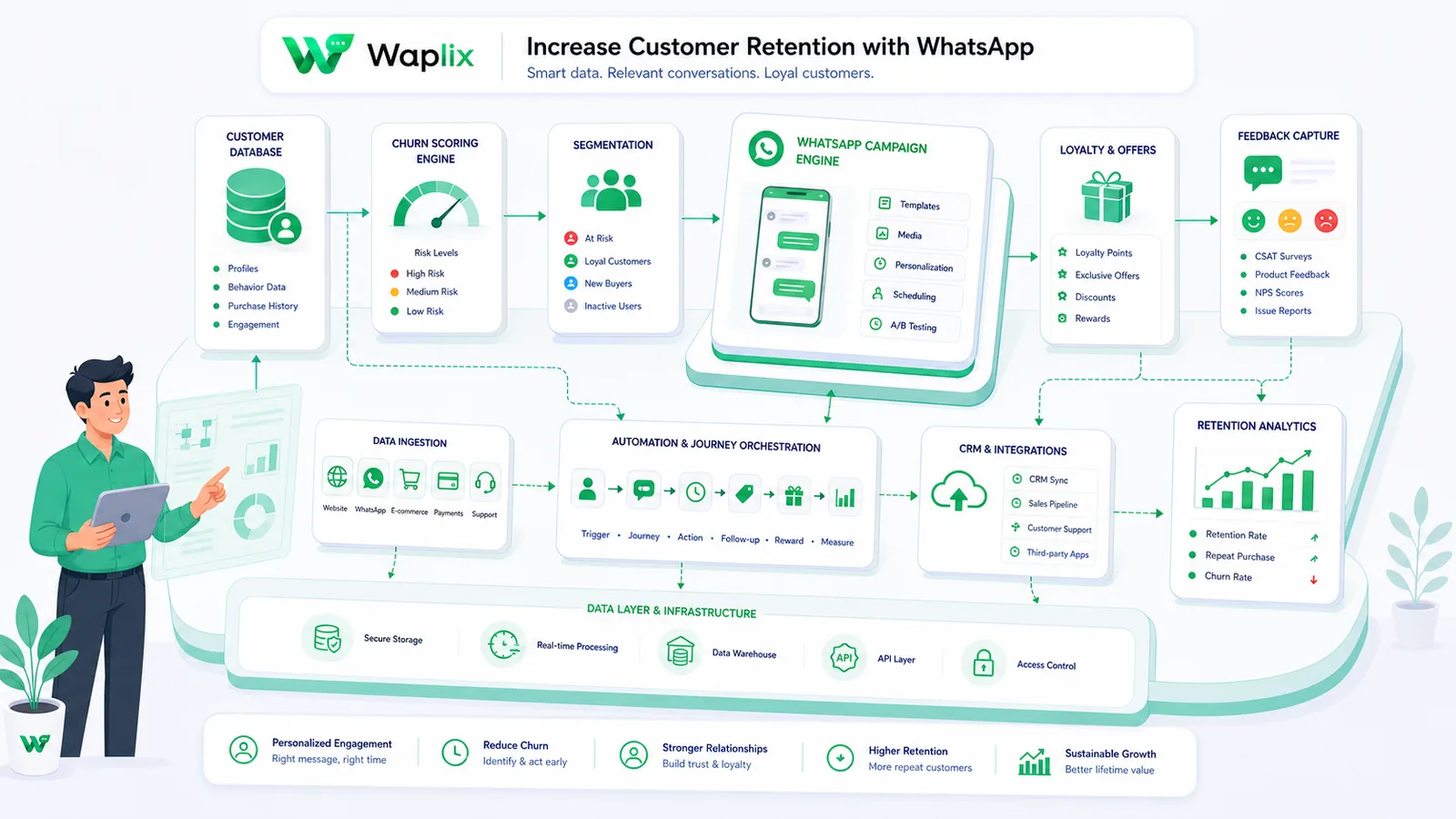
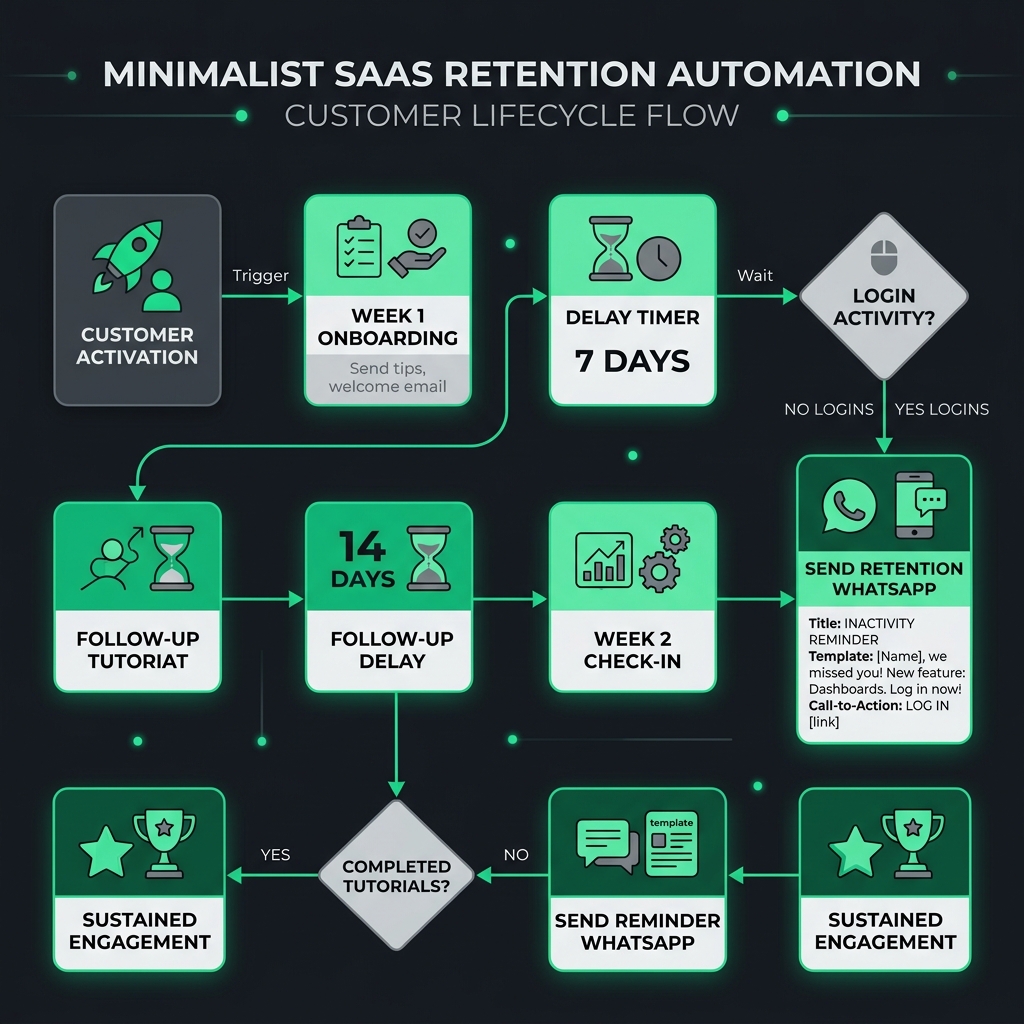
A retention workflow is event-driven: CRM events trigger WhatsApp messages at the right lifecycle moments. Here is how to structure one from scratch.
CRM lifecycle events feed automation logic that sends WhatsApp templates and tracks retention outcomes.
Step 1: Map your customer lifecycle
Identify the key moments where customers make stay-or-leave decisions: post-onboarding, first reorder window, subscription renewal, and inactivity thresholds. These are your WhatsApp trigger points.
Step 2: Define triggers and delays
Post-purchase check-in — 5 days after delivery confirmation
Feedback request — 10–14 days after purchase, after usage period
Reorder nudge — based on average repurchase cycle for the product category
Renewal reminder — 7 days before subscription expiry, then 1 day before
Win-back outreach — 60 days after last purchase with no activity
Birthday/anniversary — on the date, with offer valid for 7 days
Step 3: Build approved templates
Each lifecycle touchpoint needs a pre-approved WhatsApp template with dynamic variables for the customer name, product, date, and call-to-action link. Submit templates early—approval can take 24–48 hours.
Step 4: Route replies to your team
When customers reply to retention messages, those conversations must reach a human quickly. Route replies to a shared inbox where support or success teams can respond within minutes—not hours.
Critical: Always check customer status before sending. Do not send renewal reminders to customers who already renewed, win-back messages to customers who already repurchased, or follow-ups to customers who opted out.
Developer view: retention event to WhatsApp send
Below are simplified integration patterns for common retention scenarios. In production, validate webhook signatures, deduplicate by event ID, and respect opt-out state before every send.
Retention messages range from transactional (subscription renewal alerts) to promotional (win-back offers with discounts). Template classification matters.
Collect explicit opt-in during onboarding or at purchase for WhatsApp lifecycle messages
Classify templates correctly — renewal reminders may be utility; win-back offers with discounts are marketing
Honor opt-outs immediately and suppress across all retention flows
Respect quiet hours based on customer timezone—especially for non-urgent retention touches
Document consent records with timestamp, source, and scope for audit readiness
Follow WhatsApp Business policies and applicable local data protection laws (GDPR, CCPA, LGPD)
Important: Regulations vary by country and message type. This guide provides operational guidance, not legal advice. Consult qualified counsel for your specific markets and use cases.
See Waplix features
Build permission-based retention flows with templates, delay timers, lifecycle triggers, and re-engagement tracking.
Track metrics that show whether WhatsApp retention touchpoints genuinely extend customer lifetime—not just generate sends.
Metric
What it tells you
Repeat purchase rate
Percentage of customers who buy again within a defined window after WhatsApp touchpoint
Customer lifetime value (CLV)
Revenue per customer over their entire relationship, segmented by WhatsApp-engaged vs not
Churn rate reduction
Difference in churn between customers receiving retention messages and control group
Re-engagement conversion
Lapsed customers who return after a win-back message ÷ total win-back sends
Renewal completion rate
Subscriptions renewed after WhatsApp reminder ÷ total expiring subscriptions contacted
Reply rate
How often customers engage in conversation after retention touchpoints
Opt-out rate
Signals message fatigue, poor relevance, or excessive frequency
Cost per retained customer
Template + platform costs ÷ customers who stayed or returned
Best practice: Use control groups. Hold back 10–20% of eligible customers from WhatsApp retention flows and compare their churn and repurchase rates to measure true incremental impact.
How Waplix powers customer retention on WhatsApp
Waplix lets growth and success teams run multi-step WhatsApp retention workflows without building API infrastructure. Connect CRM lifecycle events—purchases, renewals, inactivity—to approved templates with configurable delays, conditional logic, and audience segmentation. Track delivery, replies, and re-engagement conversions from a single dashboard.
When customers reply to retention messages—asking about renewal terms, requesting help, or expressing interest—those conversations route to a shared inbox where your team can respond immediately. Retention is not just outbound messaging; it is about being available when the customer is ready to engage.
Suggested screenshot: workflow builder with post-purchase and win-back triggers, delay configuration, and template assignment.
Sending retention messages without opt-in. Even existing customers need documented consent for WhatsApp marketing messages.
Treating every customer the same. Segment by purchase history, lifecycle stage, and engagement level—a first-time buyer and a loyal VIP need different messages.
Overwhelming with frequency. More messages do not mean more retention. One well-timed touchpoint per lifecycle stage outperforms weekly blasts.
Ignoring replies. Customers who respond to retention messages are signaling engagement—unanswered replies destroy the trust you are trying to build.
Sending win-backs to active customers. Always verify purchase recency before triggering re-engagement flows.
Generic, impersonal copy. "We miss you" without product context or personalization feels like spam, not relationship-building.
No control group measurement. Without holdback testing, you cannot prove WhatsApp retention drives incremental results.
Best practices for WhatsApp retention
Start with high-impact touchpoints
Post-purchase follow-ups and renewal reminders have the clearest ROI. Build confidence before expanding to win-backs and loyalty offers.
Personalize with CRM data
Use purchase history, product preferences, and customer name in every template. Dynamic variables make messages feel individual, not mass-produced.
Coordinate across channels
WhatsApp and email should complement each other. Suppress WhatsApp sends when email already drove the action, and vice versa.
Measure incrementally
Use control groups to isolate WhatsApp retention impact from natural repurchase behavior. Report incremental lift, not total attributed revenue.
Final recommendation
Customer retention is where long-term profitability lives. WhatsApp adds a high-visibility, conversational channel to your retention toolkit—one that reaches customers where they already communicate and lets them reply when they are ready.
Start with the retention touchpoints that match your business model: post-purchase check-ins for e-commerce, renewal reminders for subscriptions, win-back campaigns for lapsed customers. Measure with control groups, personalize with CRM data, and always prioritize customer replies over outbound volume.
Retention is not about sending more messages. It is about being present at the moments that matter most in the customer relationship.
Start building with Waplix
Automate permission-based retention workflows on WhatsApp with lifecycle triggers, templates, and re-engagement tracking.
Focus on repeat purchase rate, customer lifetime value (CLV), churn rate, re-engagement conversion rate, message reply rate, and opt-out rate. Compare these metrics for customers who receive WhatsApp retention messages versus those who do not. Track cohorts monthly to identify whether WhatsApp touchpoints genuinely extend customer lifespan or simply shift existing behavior between channels.
Use dynamic template parameters populated from your CRM or order history—customer name, last product purchased, membership tier, anniversary date, and preferred language. Segment audiences by purchase frequency, recency, and average order value so each group receives contextually relevant messages rather than generic blasts. Waplix supports variable injection in approved templates for scalable personalization.
A common starting point is 30–60 days after the last purchase for consumable products, or 60–90 days for durable goods. Avoid messaging during the first week post-purchase unless you are collecting feedback. Test timing against your own churn curve—the goal is to reach customers before they lapse, not after they have already moved on.
Calculate incremental revenue from repeat purchases attributed to WhatsApp touchpoints, subtract template costs, platform fees, and staff time, then compare against your baseline retention rate without WhatsApp. Use control groups—hold back a random segment from WhatsApp retention flows—to isolate the channel effect. Avoid crediting WhatsApp for purchases that would have happened anyway.
WhatsApp complements email but rarely replaces it entirely. WhatsApp offers higher visibility and faster response for time-sensitive retention touchpoints like renewal reminders and win-back offers. Email remains effective for longer-form content like newsletters and loyalty program summaries. Use both channels together, coordinating timing to avoid duplicate messaging.
Waplix connects CRM events—purchase milestones, subscription renewals, inactivity triggers—to WhatsApp template sends with delay timers and conditional logic. Teams can build multi-step retention flows, route customer replies to a shared inbox, track re-engagement conversions, and segment audiences by lifecycle stage—all without building API infrastructure from scratch.
Related Guides & Insights
AI Agents
AI Appointment Booking on WhatsApp
Learn how to build AI-driven booking systems on WhatsApp, connecting calendar databases to conversational agents, automating updates, and reducing client no-shows.
Discover practical ways small businesses can leverage no-code AI automation on WhatsApp to manage customer conversations, qualify prospects, and coordinate bookings 24/7.
Explore the technology behind AI memory and context retention, learning how session databases personalization results in better, trust-filled client interactions.